Sadsad Tamesis Legal and Accountancy Firm

2026

Is a Fast-Food Chain Liable When a Baby Falls During a Mascot Photo-Op? PHOTO: Syda Productions

Is a Fast-Food Chain Liable When a Baby Falls During a Mascot Photo-Op? | Spouses Latonio vs. McGeorge Food Industries, Inc., G.R. No. 206184

For a recovery of damages, there must be both a right of action for a legal wrong inflicted by the defendant and damage resulting to the plaintiff therefrom. Both must exist since damages are merely part of the remedy allowed for the injury caused by a breach or wrong.

Is a Fast-Food Chain Liable When a Baby Falls During a Mascot Photo-Op? | Spouses Latonio vs. McGeorge Food Industries, Inc., G.R. No. 206184 Read More »

The vulnerable women and children: How does the Philippine law protect citizens against human trafficking? PHOTO: yuriz/GETTY IMAGES

The vulnerable women and children: How does the Philippine law protect citizens against human trafficking?

From Quiboloy’s human trafficking charges to the Epstein files, it is evident that systemic gaps persist and leave women and children vulnerable to horrendous crimes by complicit officials and people with high positions in society. In the 2023 Global Slavery Index (GSI) by the Walk Free international human rights group, the Philippines ranks seventh in the Asia Pacific region (out of 27 countries) in the prevalence and the total number of people living in any situation of exploitation or what they call “modern slavery”, and 36th out of 160 globally. The GSI estimates 859,000 that on any given day in 2021, there were 859,000 Filipinos in modern slavery, which is equivalent to 7.8 people in modern slavery for every thousand people in the country.  With one of the largest migrant populations in the world, the Philippines remains vulnerable to both domestic and overseas trafficking. Perpetrators not only include Filipino citizens but also tourists, specifically sex tourists, from more wealthy and developed countries that often dodge their sex offense charges in their home countries and look to exploit women and children here.  In the 2025 Trafficking in Persons Report in the Philippines by the US Department of State, the National Bureau of Investigation (NBI) and the Philippines National Police (PNP) investigated 500 trafficking cases (vs. 417 cases in the previous reporting period). The government prosecuted 446 alleged traffickers, 213 of whom for sex trafficking and 233 for labor trafficking (vs. 264 alleged traffickers: 217 for sex trafficking and 47 for labor trafficking in the previous reporting period).  In the end, the Courts convicted 143 traffickers, 120 for sex trafficking and 23 for labor trafficking (vs. 80 traffickers, 71 for sex trafficking and nine for labor trafficking in the previous reporting period). So, how does the Philippine law protect its citizens and punish traffickers in this case? What is the Anti-Trafficking in Persons Act of 2003 (RA 9208), as amended by Expanded Anti-Trafficking in Persons Act of 2012 (RA 10364)? The RA 9208 or the Anti-Trafficking in Persons Act of 2003 institutes measures and development of programs that will promote human dignity, protect the people from any threat of violence and exploitation, eliminate trafficking in persons, and ensure the recovery, rehabilitation and reintegration of victims into the mainstream of society. It adheres to the international human rights treaties and conventions to which the Philippine is a signatory, such as the United Nations Universal Declaration on Human Rights (UDHR),United Nations Convention on the Rights of the Child, International Convention on the Protection of Migrant Workers and their Families, United Nations Convention Against Transnational Organized Crime Including its Protocol to Prevent, Suppress and Punish Trafficking in Persons, Especially Women and Children. In 2012, the Act was amended by RA 10364, or the Expanded Anti-Trafficking in Persons Act. How does the Act define “Trafficking In Persons” (TIP)? “Trafficking in Persons” is an illegal act and a violation of human rights, characterized by three (3) interrelated and interdependent elements: These elements must all be present and be linked to each other for it to be considered “trafficking”, except in the cases of child trafficking. What are considered acts of TIP? The following are punishable under Section 4 of the Act: (a) To recruit, obtain, hire, provide, offer, transport, transfer, maintain, harbor, or receive a person by any means, including those done under the pretext of domestic or overseas employment, training, or apprenticeship, for prostitution, pornography, or sexual exploitation; (b) To introduce or match for money, profit, or material, economic or other consideration, any person or, as provided for under RA 6955, any Filipino woman to a foreigner for marriage for the purpose of acquiring, buying, offering, selling or trading him/her to engage in prostitution, pornography, sexual exploitation, forced labor, slavery, involuntary servitude or debt bondage; (c) To offer or contract marriage, real or simulated, for the purpose of acquiring, buying, offering, selling, or trading them to engage in prostitution, pornography, sexual exploitation, forced labor or slavery, involuntary servitude or debt bondage; (d) To undertake or organize tours and travel plans consisting of tourism packages or activities for the purpose of utilizing and offering persons for prostitution, pornography, or sexual exploitation; (e) To maintain or hire a person to engage in prostitution or pornography; (f)To adopt persons by any form of consideration for exploitative purposes or to facilitate the same for purposes of prostitution, pornography, sexual exploitation, forced labor, slavery, involuntary servitude, or debt bondage; (g)To adopt or facilitate the adoption of persons for prostitution, pornography, sexual exploitation, forced labor, slavery, involuntary servitude, or debt bondage; (h) To recruit, hire, adopt, transport, transfer, obtain, harbor, maintain, provide, offer, receive, or abduct a person, by means of threat or use of force, fraud, deceit, violence, coercion, or intimidation for removal or sale of organs of said person; (i)To recruit, transport, obtain, transfer, harbor, maintain, offer, hire, provide, receive or adopt a child to engage in armed activities in the Philippines or abroad; (j) To recruit, transport, transfer, harbor, obtain, maintain, offer, hire, provide or receive a person by means defined in Section 3 of this Act for purposes of forced labor, slavery, debt bondage, and involuntary servitude, including a scheme, plan, or pattern intended to cause the person either: 1. To believe that if the person did not perform such labor or services, he or she or another person would suffer serious harm or physical restraint; or 2. To abuse or threaten the use of law or the legal processes; and (k) To recruit, transport, harbor, obtain, transfer, maintain, hire, offer, provide, adopt, or receive a child for purposes of exploitation or trading them, including but not limited to, the act of baring and/or selling a child for any consideration or for barter for purposes of exploitation. Trafficking for purposes of exploitation of children shall include: 1. The use, procuring or offering of a child for illegal activities or work which, by its nature or the circumstances in which it is carried out, is likely to harm


The vulnerable women and children: How does the Philippine law protect citizens against human trafficking? Read More »

Are derogatory remarks made in a private Facebook setting a violation of Code of Professional Responsibility? | PHOTO: Tanzim Graphic Zone's & PMLM/CANVA

Are derogatory remarks made in a private Facebook profile a violation of Code of Professional Responsibility? |  A.M. No. 21-06-20-SC

A lawyer’s “locked” profile or privacy settings do not shield them from liability. Citing Belo-Henares v. Guevarra, the Supreme Court held that there is no “reasonable expectation of privacy” for Facebook posts because privacy tools are not foolproof, as information shared with “friends” can easily be shared or leaked to others outside the intended circle.

Are derogatory remarks made in a private Facebook profile a violation of Code of Professional Responsibility? |  A.M. No. 21-06-20-SC Read More »

A place for “desire” and “init”: Revisiting the Safe Spaces Act or the Bawal Bastos Law. PHOTO: STLAF

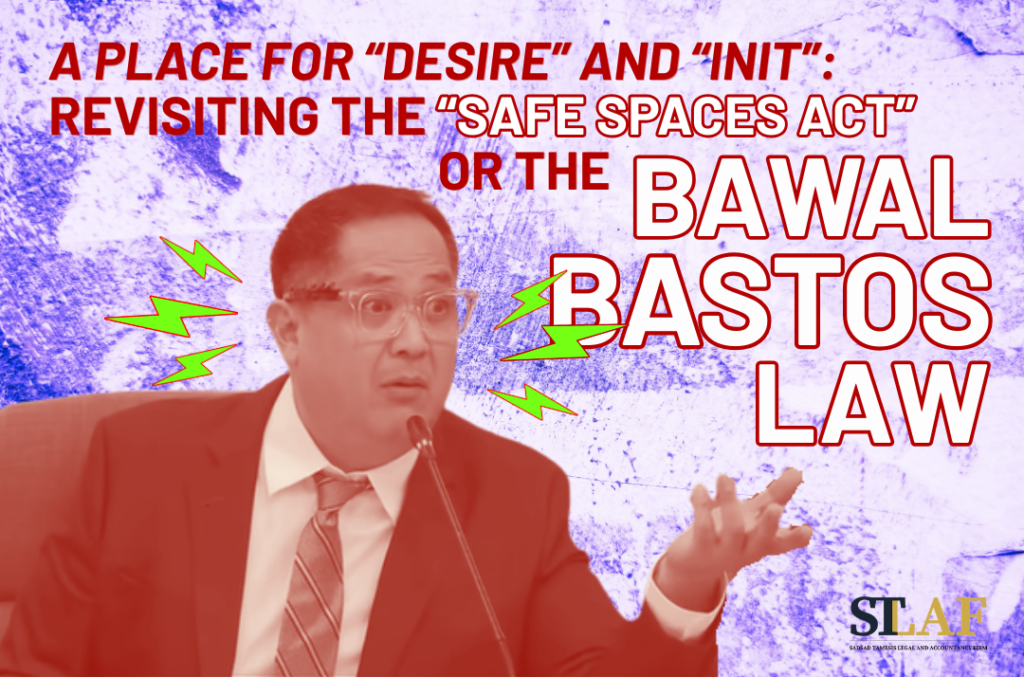
A place for “desire” and “init”: Revisiting the Safe Spaces Act or the Bawal Bastos Law

In recent developments, Quezon City 4th District Rep. Bong Suntay has been condemned by various lawmakers, human rights groups, and the general public for his obscene remarks about a public figure, made in an attempt to draw an analogy during a hearing on impeachment complaints against Vice President Sara Duterte last Tuesday. “Minsan nasa Shangri-La ako, nakita ko si Anne Curtis. Ang ganda-ganda pala niya. You know, may desire sa loob ko na nag-init talaga, at na-imagine ko na lang kung ano ang puwedeng mangyari. Pero siyempre hanggang imagination lang ’yon,” were Suntay’s exact words.  (“Last time, I was in Shangri-La, and I saw Anne Curtis. She was very beautiful. You know, a desire within me really welled and heated up, and I imagined what could’ve happened. But of course, it was only [up to] my imagination.”) In the grand year 2026 and during the National Women’s Month celebration, many understandably expressed their vitriol against this Congressman—a person who holds public trust and authority—saying such things on live television and doubling down thereafter. Many question what would compel a policymaker to do it and why he would not know the local laws pertaining tothe very act he did—gender-based harassment, and in this case, by the sexual comment he made.  This one incident out of many only underscores the ongoing struggle in combating misogyny in our everyday lives and spaces, and the relevance of our laws that tackle this societal issue. One of these laws is the Republic Act (RA) No. 11313, otherwise known as the Safe Spaces Act or the Bawal Bastos law.  What is the Safe Spaces Act (Bawal Bastos Law)? Signed into law in 2019, the Safe Spaces Act or the Bawal Bastos Law aims to define and punish catcalling and other forms of gender-based sexual harassment (GBSH). Its Declaration of Policy states that it “recognizes that both men and women must have equality, security and safety not only in private, but also on the streets, public spaces, online, workplaces and educational and training institutions.” Under the Safe Spaces Act, GBSH is classified into: Gender-based Streets and Public Spaces Sexual Harassment The crimes under this classification are committed through any unwanted and uninvited sexual actions or remarks against any person regardless of the motive for committing such action or remarks (Sec. 4). They include: ‘Verbal’ GBSH 1st offense Twelve (12) hours community service inclusive of Gender Sensitivity Training (GST) and PHP 1,000 fine 2nd offense Imprisonment of 6 -10 days or PHP 3,000 fine 3rd offense Imprisonment of 11 – 30 days and PHP 10,000 fine ‘Gestural and ‘Demonstrated’ GBSH 1st offense Twelve (12) hours community service inclusive of GST and PHP 10,000 fine 2nd offense Imprisonment of 11 – 30 days or PHP 15,000 fine 3rd offense Imprisonment of 1 month and 1 day to 9 months and PHP 20,000 fine GBSH through stalking, and physical advances such as any touching, pinching, or brushing against the genitalia 1st offense Imprisonment of 11 – 30 days or a fine of PHP 30,000 provided that it includes attendance in a GST to be conducted by PNP in coordination with LGU and PCW 2nd offense Imprisonment of 1 month and 1 day to 6 months or PHP 50,000 fine 3rd offense Imprisonment of 4 months and 1 day to 6 months or PHP 100,000 fine Additional if the perpetrator is a driver or operator of a PUV Cancellation of license of the driver by the Land Transportation Office (LTO) Suspension or revocation of franchise by the Land Transportation Franchising and Regulatory Board (LTFRB). This sanction may be imposed upon order by the proper court OR upon order of LTO/LTFRB in an administrative proceeding If the perpetrator is a minor The Department of Social Welfare and Development (DSWD) shall take necessary disciplinary measures as provided for under Republic Act No. 9344, otherwise known as the “Juvenile Justice and Welfare Act of 2006″. List of penalties for gender-based sexual harassment (GBSH) in streets and public spaces under RA 11313 Article I, Sec. 11(a)(b)(c); format from Philippine Commission on Women (PCW). Where can victims of GBSH in streets and public spaces reach out for help? In all cases Local Government Unit via local Anti-Sexual Harassment (ASH) hotlineNearest police precinct through their Women and Children’s Protection DesksLocal Social Welfare and Development OfficePublic Attorney’s Office subject to PAO’s Persons Qualified for Legal Assistance Streets, roads, alleyways, parks Local traffic enforcer PUVs by a driver or operator of PUV  Local Traffic Enforcer, LTO, LTFRB Close proximity to the LGU Hall Anti-Sexual Harassment (ASH) Desk Officer of the LGU (Provincial, Municipal, City, or Barangay) Malls, Bars, Public Establishments ASH Officer designated by operator of Malls, Bars, Public Establishments(e.g. security officers) List of authorities a victim can reach in case of GBSH in streets and public spaces according to RA 11313; format from Philippine Commission on Women (PCW). Gender-Based Online Sexual Harassment The crimes under this classification include acts that use information and communications technology in terrorizing and intimidating victims through: In general Corrective prison (prision correccional) in its medium period or a fine of not less than PHP 100,000.00 but not more than PHP 500,000.00, or both, at the discretion of the court If the perpetrator is a juridical person License or franchise shall be automatically deemed revoked, and the persons liable shall be the officers thereof, including the editor or reporter in the case of print media, and the station manager, editor and broadcaster in the case of broadcast media If the perpetrator is a foreigner (alien) Subjected to deportation proceedings after serving sentence and payment of fines. List of penalties for perpetrators of online GBSH according to RA 11313 and PCW. Where can victims of online GBSH reach out for help? The PNP Anti-Cybercrime Group (PNPACG) as National Operational Support Unit of the PNP, in collaboration with the Department of Information and Communications Technology (DICT), is responsible for the implementation and enforcement of Philippine laws on cybercrime. They receive complaints about GBSH and develop

A place for “desire” and “init”: Revisiting the Safe Spaces Act or the Bawal Bastos Law Read More »

Can tax declarations be considered as proof of ownership instead of a registered title? PHOTO: Stoica Adrian

Can tax declarations be considered as proof of ownership instead of a registered title? | Ebancuel, et al. v. Acierto, et  al., G.R. No. 214540

NO. The respondents’ tax declarations are insufficient proof of ownership. A tax declaration does not prove ownership, but rather serves as an indicium of possession in the concept of ownership.

Can tax declarations be considered as proof of ownership instead of a registered title? | Ebancuel, et al. v. Acierto, et  al., G.R. No. 214540 Read More »

Is a Property Exempt From Execution as “Family Home” After Mortgage and Foreclosure? PHOTO: Handmadefont/CANVA

Is a Property Exempt From Execution as “Family Home” After Mortgage and Foreclosure? | G.R. No. 257251

This case examines whether heirs may still invoke the family home exemption after the property was waived in favor of one heir, mortgaged to a bank, and was later subject to foreclosure due to loan default. The Supreme Court clarified the limits of the family home exemption, emphasized the importance of timely invocation before the sheriff, and outlined the protection afforded to a mortgagee acting in good faith.

Is a Property Exempt From Execution as “Family Home” After Mortgage and Foreclosure? | G.R. No. 257251 Read More »

https://157.245.54.109/ https://128.199.163.73/ https://cadizguru.com/ https://167.71.213.43/
Scroll to Top