
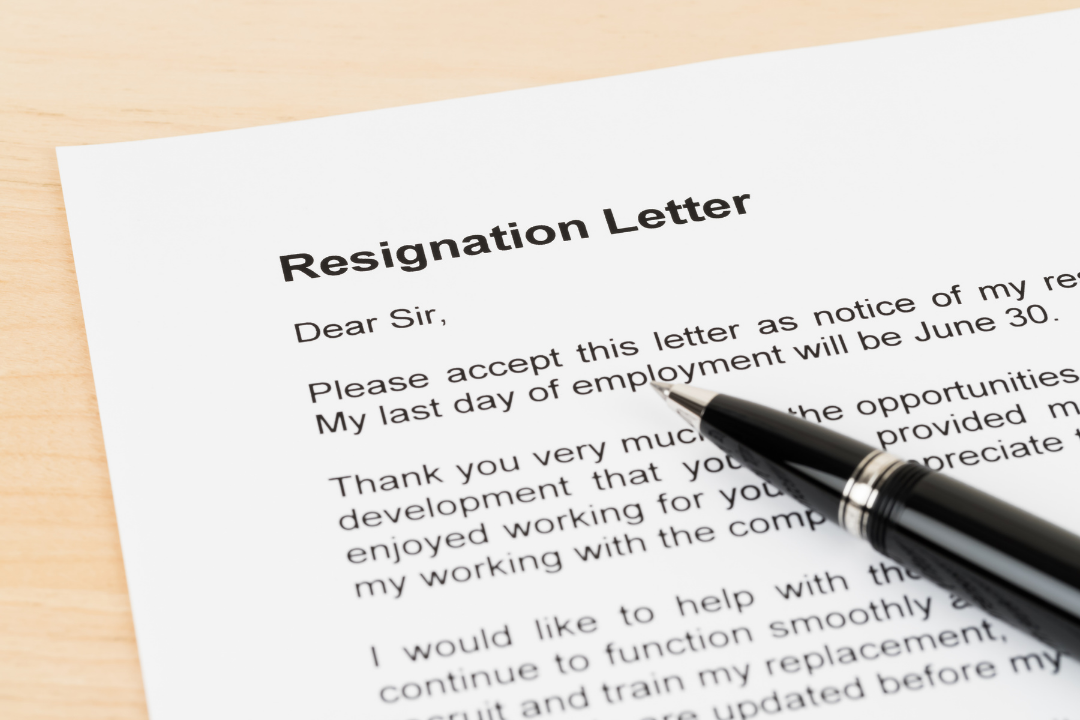
‘Kelan ka mag-re-resign?’ (‘When are you going to resign?’) is the common, sometimes sad, sentiment shared among employees and workers every December to January—the ‘resignation season’ or ‘resignation wave’, as HR would call it.
As concerning as it may be for an employer, resignation is a legal, voluntary right of an employee to terminate their own employment. Now, where does this leave the employers?
Employees are protected under several labor laws, but so are employers, as resignation or any termination of a contract thereof follows a process that both sides must follow.
Here are FAQs on resignation, notice period, and final pay you should know.
What do you mean by resignation?
Pascua v. Bank Wise Inc. conceptualizes resignation as “the voluntary act of an employee who is in a situation where one believes that personal reasons cannot be sacrificed in favor of the exigency of the service, and one has no other choice but to dissociate oneself from employment.”
In P.D. 442, otherwise known as the Labor Code of the Philippines, or simply the Labor Code, resignation is officially deemed as a ‘termination by employee’ of an employment:
ART. 300. [285] Termination by Employee. (a) An employee may terminate without just cause the employee-employer relationship by serving a written notice on the employer at least one (1) month in advance.
What is voluntary and involuntary resignation?
By concept, any resignation is a ‘voluntary’ resignation; however, certain conditions make it otherwise. In involuntary resignation, an employer coerces an employee to quit, which is illegal and considered constructive dismissal, a form of illegal termination.
In Gan v. Galderma Philippines, Inc., constructive dismissal is whether a reasonable person in the employee’s position would have felt compelled to give up his employment/position under the circumstances. In this case, the employer may be subject to penalties and shall provide proof that the resignation was, in fact, voluntary.
Can an employer refuse or deny your resignation?
In short answer, no. Employers cannot refuse or reject an employee’s resignation. Resignation is not subject to permission or approval.
However, they can defer a resignation for the right reasons, like a pending administrative case. With deferment, it is not about waiving the right to resign, but rather, respecting both the right of an employee to due process and management’s prerogative to fire.
Aside from this, an employer cannot withhold a Certificate of Employment (COE) and final pay without just cause.
Do I legally have to follow the four (4) week or thirty (30)-day notice period?
The general rule is clear: an employee who resigns without just cause must serve a written notice at least thirty (30) days in advance to give employers reasonable time to transition, find a replacement, and ensure continuity of operations. Think of it as a courtesy grounded in law, not just office etiquette.
That said, the law also recognizes that not all resignations can wait 30 days. An employee may resign immediately (immediate resignation), or with a shorter notice for just causes, such as:
- Serious insult or inhuman treatment by the employer or their representative
- Commission of a crime or offense by the employer against the employee
- Other analogous causes that make continued employment unreasonable
In these cases, the employee is not liable for failure to comply with the notice period.
On the flip side, if an employee resigns without just cause and does not complete the 30 days, the employer may:
- Withhold pay equivalent to the unserved portion of the notice period, if there is a valid company policy or agreement, or
- Claim damages, provided these are proven and reasonable
- Article 2199 of the Civil Code. Except as provided by law or stipulation, one is entitled to an adequate compensation only for such pecuniary loss suffered by him as he has duly proved. Such compensation is referred to as actual or compensatory damages.
What employers cannot do is force an employee to stay beyond the notice period or treat resignation as an act of misconduct because the resignation is effective from the day the employee submitted it to the last day of their notice or turnover period, whether they were required by the company or not.
What is a final pay and when should I receive it?
According to the Department of Labor and Employment (DOLE)’s Labor Advisory 06-20, final pay (also called back pay) refers to all monetary benefits due to an employee upon termination of employment. This usually includes:
- Unpaid salaries
- Pro-rated 13th-month pay
- Cash equivalent of unused service incentive leave (if applicable)
- Other benefits under the company policy or contract
As reiterated by the advisory, final pay should be released within thirty (30) days from the date of separation, unless a shorter period is provided by company policy or a collective bargaining agreement.
Importantly, final pay cannot be withheld as leverage:
- Not for unfinished turnover
- Not for lack of clearance, if the delay is unreasonable
- Not to “punish” the employee for resigning
Clearance procedures may justify a reasonable delay, but they are not a free pass to indefinitely hold an employee’s money. Employers must still act in good faith and within a reasonable timeframe.
Should you have concerns or require related services, our Firm offers legal solutions customized for your labor law needs, whether you are a local or international client.
Disclaimer: The content of this blog is intended for general informational and educational purposes only and does not constitute legal advice. Laws and regulations may vary by jurisdiction, and the applicability of the information herein may differ depending on specific facts and circumstances. Accessing or reading this content does not create an attorney–client relationship. For legal concerns or tailored guidance, please consult a qualified lawyer licensed in your jurisdiction.
Whether you are based in the Philippines or overseas, STLAF offers legal services to both local and international clients. Our team is equipped to assist with cross-border matters, provide jurisdiction-specific guidance, and help you navigate complex legal challenges with confidence.
To read more STLAF legal tidbits, visit https://stlaf.global/bits-of-law.
For comments, suggestions, and inquiries, email legal@sadsadtamesislaw.com.
Author/s: Patricia Minimo
About the author(s):  Patricia is STLAF's Legal Writer-Researcher. She is a Communication graduate from the University of the Philippines – Baguio with a major in Journalism and a minor in Speech Communication.