Sadsad Tamesis Legal and Accountancy Firm

Author name: Patricia Minimo

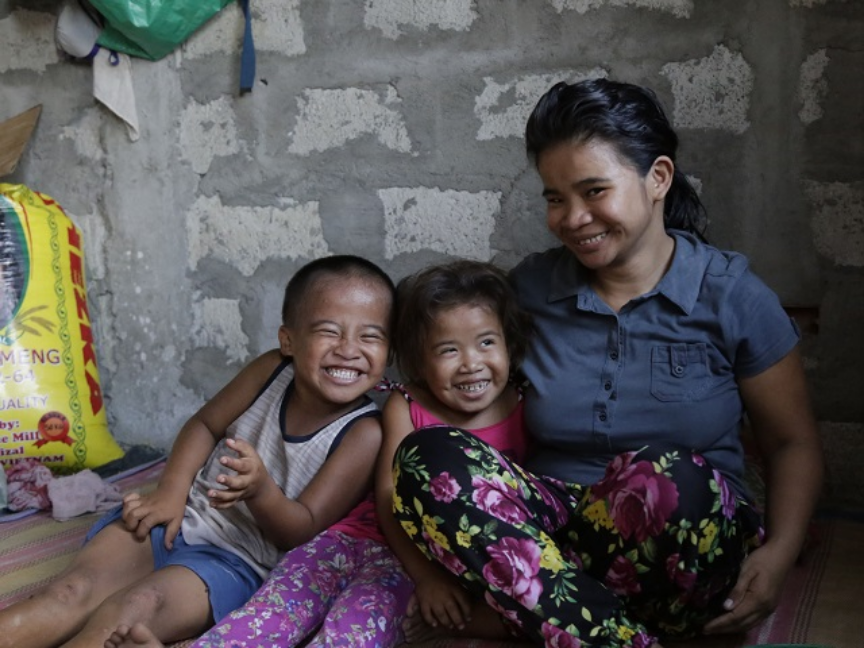
save the children photo mother with her two children

Solo, Not Alone: Solo Parents and the Expanded Solo Parents Welfare Act

In celebration of Solo Parents Week, we look at the legal framework that reinforces the rights and entitlements of solo parents under RA 11861. Signed into law in June 04 2022, the measure builds on the foundation of RA 8972, or the Solo Parents Welfare Act, and reflects a more robust and responsive approach to modern family realities.

Solo, Not Alone: Solo Parents and the Expanded Solo Parents Welfare Act Read More »

banana plant supervisor negligence

Can a supervising authority be held liable for a student’s negligence during a school activity? | G.R. No. 219686

As a supervising authority, one is expected to take the necessary precautions to ensure not just the safety of the participants but likewise third persons in the immediate vicinity who may be affected, and to take due care in supervising and instructing those participating in the activity in the execution of their tasks, especially for minor participants.

Can a supervising authority be held liable for a student’s negligence during a school activity? | G.R. No. 219686 Read More »

de minimis ph money peso

What are de minimis benefits?

In the Philippines, benefits come in taxable and non-taxable forms. De minimis benefits are small, non-taxable (neither by income, withholding, nor fringe) compensation/perks given by employers that aim to enhance employee wellbeing and morale per Section 2.78.1 of the Revenue Regulations No. 02-98 (RR No. 2-98), as amended by RR No. 11-18, and Section 33(C) of the National Internal Revenue Code of 1977 (NIRC), as amended by the by the Tax Reform for Acceleration and Inclusion (TRAIN) Law.

What are de minimis benefits? Read More »

employee dismissal

Is employee dismissal due to loss of trust and confidence always justified? | G.R. No. 209085

To us, dismissal should only be a last resort, a penalty to be meted out only after all the relevant circumstances have been appreciated and evaluated to ensure that the ground for dismissal was not only serious but true. The cause of termination, to be lawful, must be a serious and grave malfeasance to justify the deprivation of a means of livelihood.

Is employee dismissal due to loss of trust and confidence always justified? | G.R. No. 209085 Read More »

stlaf tax return itr aitr

Beginner’s Guide to Filing Income Tax Returns

Those who make a living solely through compensation income usually don’t have to worry about filing their own income tax returns, as their employer handles it for them. However, many people aspire to gain income from multiple sources, such as freelancing. If you’re thinking of doing the same, you must first learn about the basics of filing an income tax return.

Beginner’s Guide to Filing Income Tax Returns Read More »

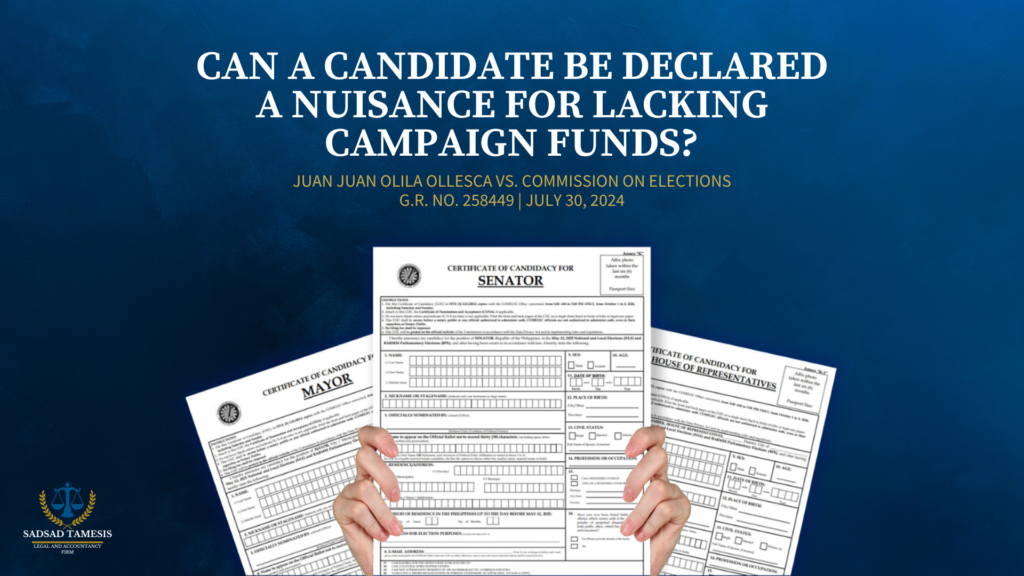
Can a candidate be declared a nuisance for lacking campaign funds?  | G.R. No. 258449

A nuisance candidate is one whose candidacy was lodged merely to create confusion or whose candidacy mocks or causes disrepute to the election process, hence, there is patently no intention to run for office. A candidate without the machinery of a political party or the finances to mount the nationwide campaign “cannot be lumped together with another candidate who was found to have mocked or caused disrepute to the election process.

Can a candidate be declared a nuisance for lacking campaign funds?  | G.R. No. 258449 Read More »

violence vawc

What is the Anti-Violence Against Women and Their Children Act of 2004

Trigger warning: This blog mentions physical and sexual violence against women and children. In the 2024 Women and Men Fact Sheet released by the Philippine Statistics Authority (PSA), results showed a disturbing number of 19,228 women aged 15-49 have experienced various forms of physical and sexual violence. This 2022 National Demographic and Health Survey (NDHS) by the PSA tells of an alarming fact that violence against women and children (VAWC) persists in the Philippines. As of February 2024, there was a total of 16.9% increase in the cases reported to the Philippine National Police Crime Information, Reporting and Analysis System (PNP CIRAS) from 11,307 cases in 2022 to 13,213 cases in 2023. A number of 7,161 cases in 2022 and 7,764 in 2023 (8.4% increase) are violations against Republic Act No. 9262, or the Anti-Violence Against Women and Their Children Act of 2004. Additionally, 2,191 cases (1,575 girls and 616 boys) of child abuse or violence against children were reportedly served by the Department of Social Welfare and Development (DSWD) in 2023. This is a 39.4% decrease from the previous 3,616 cases in 2022, however, the point stands that this is still a serious problem in the country. “Violence against women (VAW) appears as one of the country’s pervasive social problems,” said the Philippine Commission on Women (PCW), the government-mandated agency at the center of women’s and children’s rights supervision, enforcement, and protection.  As such, this Women’s Month and the upcoming celebration of Girl Child Week per Proclamation No. 759, s. of 1996, awareness of women’s and children’s rights and the laws that protect them is once again underscored. Anti-Violence Against Women and Their Children Act of 2004 (RA 9262) The Anti-Violence Against Women and Their Children Act of 2004, or simply the Anti-VAWC Act, seeks to recognize and address the need to protect the family and its members particularly women and children, from violence and threats to their safety and security. According to the UN Declaration on the Elimination of Violence against Women in 1993, VAW is “any act of gender-based violence that results in or is likely to result in physical, sexual or psychological harm or suffering to women, including threats of such acts, coercion or arbitrary deprivation of liberty, whether occurring in public and private life. Gender-based violence is any violence inflicted on women because of their sex.” Following this and other international human rights instruments to which the Philippines is a party, the Anti-VAWC Act defines ‘violence against women and children’ as any act or a series of acts committed by any person  which result in or is likely to result in physical, sexual, psychological harm or suffering, or economic abuse What is considered VAWC under the Anti-VAWC Act? VAWC includes: Likewise, Section 5 of the Act clarifies which acts qualify as a crime of VAWC. These include the following: Penalties against violations and crimes under Anti-VAWC Act The penalties of committing an act listed in RA 9262 vary and depend on the severity of the act. Act of Violence Duration of Penalty Attempt to harm the victim 1 month and 1 day – 6 months  Place the victim in fear of imminent physical harm 1 month and 1 day – 6 months Threaten to or does self-harm to control the victim’s actions or decisions 1 month and 1 day – 6 months Restrict the victim from doing something through force or intimidation 6 months and 1 day – 6 years Force the victim into doing something through force or intimidation 6 months and 1 day – 6 years Attempt to or do any form of sexual violence on the victim 6 years and 1 day – 12 years Cause emotional or psychological distress to the victim through behaviors such as stalking, destroying the victims property, etc. 6 years and 1 day – 12 years Cause mental or emotional anguish, public ridicule, or humiliation to the victim 6 years and 1 day – 12 years If the acts are committed while the woman or child is pregnant or committed in the presence of her child, the penalty to be applied shall be the maximum period of penalty prescribed in the section. In addition to imprisonment, the perpetrator shall pay a fine of not less than P100,000.00, but not more than ₱300,000.00. He or she must also undergo mandatory psychological counseling or psychiatric treatment and shall report compliance to the court. Protection Orders While a victim can file a case against his or her perpetrator for his or her act of violence, it doesn’t guarantee with certainty that the perpetrator won’t endanger the victim again. To prevent this from happening, the victim can apply for a protection order.  A protection order prevents further acts of violence against a woman or her child. It also provides these victims other forms of necessary relief. A protection order aims to safeguard the victim from further harm, minimizes disruption in the victim’s daily life, and facilitates the victim’s opportunity and ability to independently regain control over her life. There are three types of protection orders that may be issued under this Act: the barangay protection order (BPO), temporary protection order (TPO) and permanent protection order (PPO). Barangay Protection Orders, or BPOs, refer to the protection order issued by the Punong Barangay ordering the perpetrator to desist. A Punong Barangay shall issue the protection order to the applicant on the date of filing. If the Punong Barangay is unavailable to act on the BPO application, the application shall be acted upon by any available Barangay Kagawad. BPOs are effective for fifteen days. Temporary Protection Orders, or TPOs, refer to the protection order issued by the court on the date of filing of the application. They are effective for thirty days. The court shall also schedule a hearing on the issuance of a PPO prior to or on the TPO’s expiration date.  Permanent Protection Orders, or PPOs, refer to protection orders issued by the court after a notice and hearing. The court

What is the Anti-Violence Against Women and Their Children Act of 2004 Read More »

Child watching airplane leave for overseas. OFW.

Can an overseas Filipino worker lose parental authority or custody of their children due to absence? | G.R. No. 266116

Facts On 16 October 2019, David filed the Petition for Habeas Corpus, praying that an order be issued directing respondents to produce the bodies of his and Harryvette’s two minor children, Rocco and Zahara.  Sometime in 2012, David, an Italian citizen, met Harryvette in La Union, and they began a romantic relationship. Later, they flew to Santa Fe, Bantayan Island in the Province of Cebu. Sometime in 2015, David and Harryvette’s marital relations crumbled. Haryvette alleged that David would physically abuse her, leading to their eventual separation.  In 2018, Harryvette left for Paris, France to find work. A year later, Harryvette returned to the Philippines with her new partner. Afterward, Harryvette again left for France and turned over the custody of their minor children to David.  In July 2019, Harryvette returned to the Philippines. During that time, she and her mother, Joselyn, learned that David went to Thailand for 12 days and left their children in the care of some couple in Bantayan, Cebu, without Harryvette’s knowledge and consent.  Later on, Harryvette then executed a notarized document dated September 4, 2019, authorizing Joselyn to act as the guardian of her children upon her return to Paris. On 7 October 2019, David visited Rocco and Zahara and demanded their custody from Joselyn. However, Joselyn refused his plea and insisted that she had a better right of custody than David pursuant to the authority granted her by Harryvette.  The RTC denied David’s petition and granted Harryvette exclusive parental authority over the minors and allowed only visitation rights to David.  The CA partly granted David’s appeal, declaring that he and Harryvette have joint parental authority over their minor children. Nonetheless, it upheld the RTC’s award of provisional custody to Joselyn and the grant of visitation rights to David.  Hence, this Petition.  In his Petition, David argues that the CA should have awarded them joint custody over the children as Article 213 of the Family Code does not explicitly confer to the mother sole parental authority or sole custody. David likewise contends that Harryvette should be considered “absent” within the contemplation of Art. 212 of the same Code for being away from her place of usual residence. Ruling On the issue of custody, The SC affirms the award of sole custody over the minor children to respondent Harryvette.  Contrary to David’s claims, Harryvette cannot be considered “absent” in contemplation of Art. 212 of the Family Code.  In line with the case of Espiritu, it does not follow that the parent who is in close proximity to the minor child is the most suitable to be entrusted with their care. As applied here, the mere fact that a parent is an overseas Filipino worker does not deprive them of their right to exercise parental authority or sole custody.  Respondent has not been remiss in exercising her right to parental authority and custody over their minor children despite being overseas. Respondent makes a continuous effort to communicate with their children and watch them through a CCTV system. She is also able to financially support them.  Respondent Harryvette is likewise able to exercise sole custody through the grant of provisional custody to respondent Joselyn. This springs from the respondent’s right under Art. 213 of the Family Code as their mother, and thus, is effective only while she is away.  Between respondent Joselyn and Petitioner, it is Joselyn who can better give her full and undivided attention to the minor children and provide them with an environment most conducive to their development. This is as opposed to the latter, who was deemed unfit, being a habitual drinker and smoker, and who has previously exhibited violent tendencies.

Can an overseas Filipino worker lose parental authority or custody of their children due to absence? | G.R. No. 266116 Read More »

https://157.245.54.109/ https://128.199.163.73/ https://cadizguru.com/ https://167.71.213.43/
Scroll to Top